
NEW: Limited Edition Luminous Discover now

12. Episode:  Daniel Donskoy // Musik und Literatur


Für jede Kunst ein Notizbuch


Daniel Donskoy bewegt sich mühelos zwischen Musik, Schauspiel und Literatur. In Notizbüchern nehmen seine Melodien Gestalt an, Charaktere beginnen zu atmen und flüchtige Ideen finden einen Ort, an dem sie bleiben

Mr Donskoy, you are a musician, actor and writer. Which of your art forms rely on notebooks?

Pretty much all of them, to be honest. They’re most essential for my music. When I write songs, I need to put them on paper with a pen. Even the physical movement of the pen influences the melody that comes to me. Calligraphy, in a way, shapes how I understand the musicality of an idea.

How did you write your book “Brennen” (Burning)?

The actual manuscript was written on a computer, but everything before and after happened by hand. I went through old notes, diaries and letters while developing the story. As soon as parts of the manuscript were finished, I printed them out and annotated them by hand. Later, during the editing process, I transferred my notes into notebooks.

How important are notebooks in your daily life?

I always carry at least one with me. Sometimes I overhear a sentence on the street and write it down immediately. On my desk, I keep different notebooks for different purposes: one for music, one for writing, one for organisation.

"When I write songs, I have to put them down on paper by hand. The movement of the pen shapes the melody.”
Why don’t you use apps instead?

My problem with apps or digital notes is that they multiply endlessly. I write down a single word and immediately open a new note – it becomes totally chaotic. With notebooks, I can keep things contained. I also use them for my weekly to-do lists. I love ticking things off and crossing them out.

What can a pen do better than a smartphone or tablet?

It reveals a person’s individuality and captures the moment. A typed letter always looks the same, but handwriting is individual. You can see the mood you were in, whether you were rushed or relaxed. The entire context is embedded in the writing itself.

And what does the digital world do better?

Communication. Sharing messages and notes – that’s where digital tools really shine.

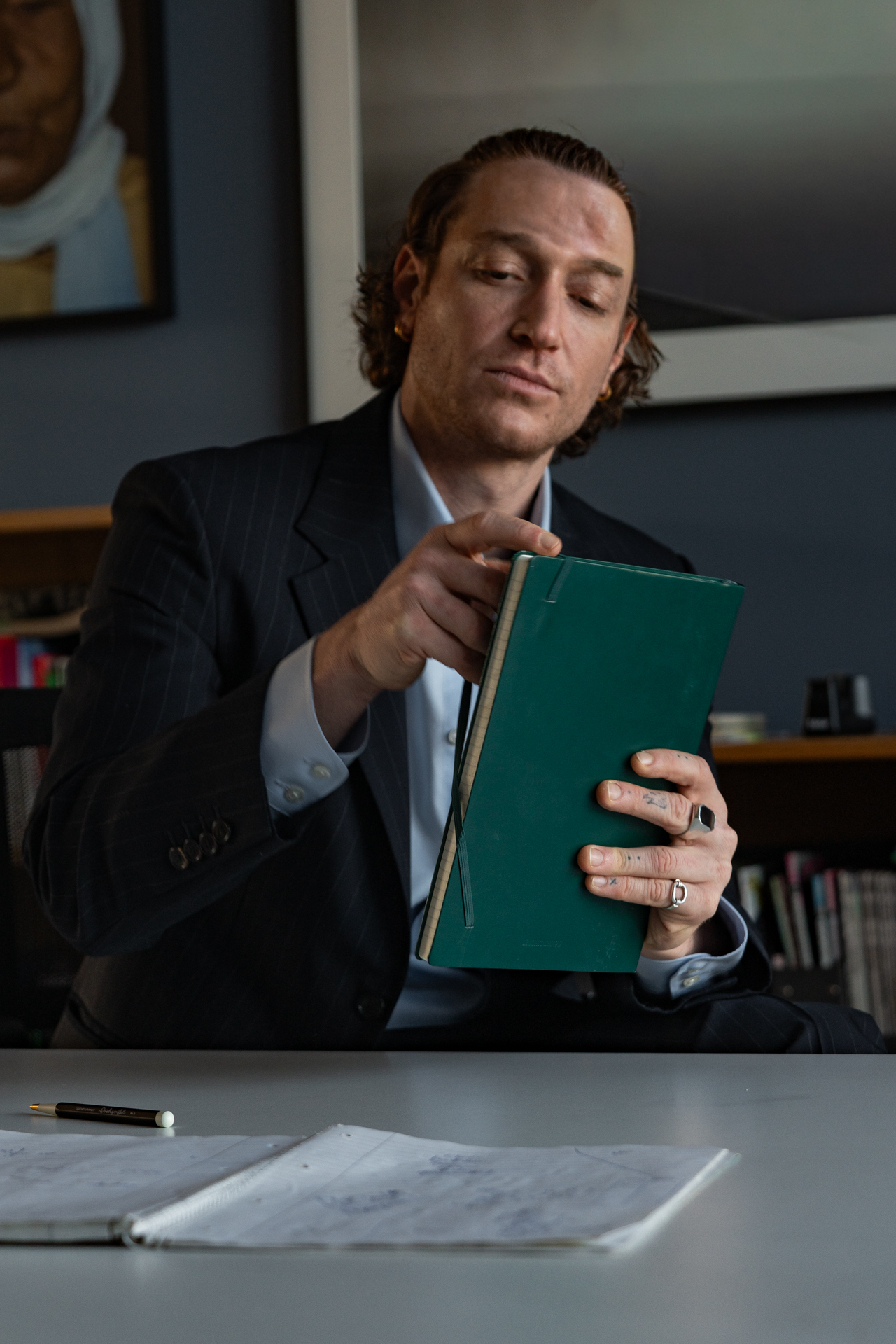
Daniel Donskoy verschließt Notizbuch mit dem Gummiband

Do your handwritten texts differ from your digital ones?

Very much so. What I write by hand feels more authentic because I’m writing purely for myself. As soon as I type, I’m aware of my communication. That alone changes the text.

Do you also take notes for your work as an actor?

Absolutely. I print everything out – I really dislike reading digitally. I still read physical books; I need paper. When I work through scripts, I mark beats and rhythms, note shifts in mood or tone. My scripts look awful in the end – they’re covered in notes and drawings.

LT1917_W_T_DD_kleiner

„Diese Verbindung von Kopf zu Hand zu Papier ist besser als alles Digitale. Was ich handschriftlich festhalte, verankert sich anders.

How important is the material to you? Colours? Paper?

I’m not set on anything in particular. I use small notebooks, but also large,m leather-bound ones. As long as I have paper and a pen, I’m fine.

Ballpoint pen or pencil?

I like erasable ballpoint pens. The best of both worlds.

Lined. Otherwise I start drifting diagonally.

Lined. Otherwise I start drifting diagonally.

Do you finish a notebook before starting a new one?

No, I usually have several on the go. I start at the front, fill about a third, then turn the book around and continue from the back. In the end, there’s a third at the front and a third at the back, and I’m constantly flipping between them. At some point, I move on to a new one. A brand-new notebook puts me under pressure – as if it demands to be filled by my writing. I prefer old notebooks. I still have my very first song notebook with my earliest lyrics. I love reading what I was thinking fourteen years ago.

So you keep your notebooks?

Actually, yes. Although I once had a fire in my flat and many of them were destroyed. I still have the really old ones; they’re in my mother’s basement.

What happens when you read old notes?

I remember the feeling I had when I wrote them. I mentioned that I worked through old diaries while writing my book – and my handwritten notes allowed me to recognise my emotional state back then. That helped me describe those emotions more accurately in the book. Writing by hand doesn’t just serve reflection; it also deepens memory. It becomes richer, more authentic.

rundes Portraitbild von Daniel Donskoy

Daniel Donskoy

Daniel Donskoy, 36, is a German actor, musician, director and author. Donskoy was born in Russia in 1990, shortly after which his family fled to Berlin (his mother is from Ukraine, his father from Russia). He spent his childhood and youth in Berlin, and from 2002 onwards in Tel Aviv, where he lived with his mother. At the age of 18, Donskoy returned to Berlin, working as a bartender and model. From 2011 to 2014, he trained in acting and musical theatre at the Arts Educational School in London and spent a semester at the Lee Strasberg Institute in New York.

Donskoy then went on to perform successfully in London musicals, and since 2016 he has appeared in TV, series and film productions, including “Victoria”, “The Crown” and “Strike Back”. Since February 2019, he has played the forensic pathologist Nick Schmitz alongside Maria Furtwängler in “Tatort”. In the same year, Donskoy released his first single, followed by further albums. His talk show “Freitagnacht Jews” (ARD media library and WDR) was awarded the Grimme Prize in 2022. His first novel, “Brennen”, was published in autumn 2025. Daniel Donskoy has been living in London since 2019.


Rundes Portrait Autorin Mirna Funk

Author Mirna Funk

Mirna Funk is a writer and essayist. She writes about culture, politics and Jewish life. Her novels and essays combine analytical acuity with literary clarity. In addition to her journalistic work, she leads seminars and curates international projects. Funk lives and works in Berlin and Tel Aviv.

More Episodes

leuchtturm1917_writers-and-thinkers_Episode-9_neil-gower_homepage

Episode 9

Neil Gower // Illustration and Typography

The pleasure of putting pen to paper

Neil Gower is an internationally acclaimed illustrator of books and maps. He started drawing at the age of eight and hasn’t stopped since.

Read more

leuchtturm1917_writers-and-thinkers_episode-10_lisa_morgenstern_homepage

Episode 10

Lisa Morgenstern // Music and film

Composing with pen and paper

Lisa Morgenstern is a pianist, singer and composer. She writes soundtracks for successful television series and creates complex worlds of sound. She uses pen and paper to capture many of her wonderful ideas.

Read more

leuchtturm1917_writers-and-thinkers_Episode-11_Steffen-Mumm_homepage

Episode 11

Steffen Mumm // Art and productivity

Creative paper chase

Steffen Mumm is an artist. He works with canvases, spray cans and printing plates. He makes signet rings, socks and silk cloths; he loves Bullet Journals, sketchbooks and notebooks. He makes notes in advance of everything he draws, paints and produces. Is this madness? No, creativity!

Read more